Page still under construction
Lacing set ups
As someone who used to do a lot of sports growing up I know how important having fitting shoes is. This is still key with skates so learning to tie them correctly for you can really help with the fit.
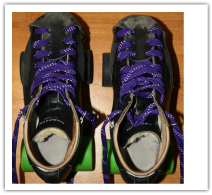 Photo by Buffy Smothers.
Rubbing on the right of your feet
This more than often occurs on the right foot (this is why it - the knot - is only on the right skate in this picture). This method incorporates a standard lace up but half way up the skate you tie a knot. This means you can tie the top half of your skate (the part near your ankle) really tightly and tie the first half leaving slightly more room alleviating pressure from the lower part of your foot.
This can also be done with two sets of shorter laces, lace one up half way then tie in the second lace to the next part of your skate.
This more than often occurs on the right foot (this is why it - the knot - is only on the right skate in this picture). This method incorporates a standard lace up but half way up the skate you tie a knot. This means you can tie the top half of your skate (the part near your ankle) really tightly and tie the first half leaving slightly more room alleviating pressure from the lower part of your foot.
This can also be done with two sets of shorter laces, lace one up half way then tie in the second lace to the next part of your skate.
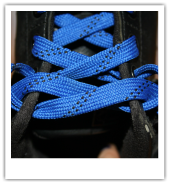
If your heel is slipping or as a standard tie
This is essentially the same as above, with or without the knot, except at the top you create a loop for the laces to go through before being tied up. You will tend to find however tight you tie your skates they will loosen around your ankle, this method really helps prevent this. This method is not necessary with skates that already have an inbuilt ankle strap (like the Reidell 495's above) or a velcro strap like many freshmeat skates do. |
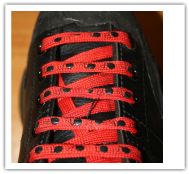
If you have toe problems
First of all cut your toenails as this can often be one of the causes of toes hurting. If they still hurt, try this lace up method, which is designed to lift up the front part of your skate to reduce stress on toes and nails as well as corns. This method involves lacing the whole skate with one half of the lace and sending the other half straight from the bottom eyelet to the top eyelet. |
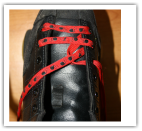
If you have high arches
This is one I am less familiar with myself as I am quite flat-footed. However, I have read that it can really help reduce pressure from the different parts of the skate for slightly more comfort. This method involves lacing the skate straight across from eyelet to eyelet rather than the more frequently used diagonal lace up method. After a lace has gone through two eyelets |
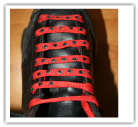
next to each other then skips over the next eyelet to enter that one. Therefore one laced side of the skate should enter 1, 2, 4, 5, 7, 8. Whereas the lace on the other side of the skate will enter eyelets: 1, 3, 4, 6, 7, 8.
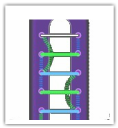
The cartoon illustration [1] where each lace is drawn in a different colour depicted the easiest way of doing this.
|
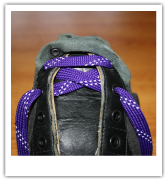 Photo by Buffy Smothers. Photo by Buffy Smothers.
Lacing Snouts
This is the sort of lacing I do when I have a snout on my skate with several holes up the side. This method allows for manoeuvrability of the foot inside but keeps the snout firmly in place quite well. This can be used with various lacing combos. |
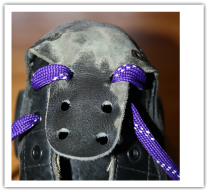 Photo by Buffy Smothers. Photo by Buffy Smothers.
Start by lacing up normally, like in the picture on the far left. Next pull the snout down and loop the lace from the eyelet through the snouts outside holes. Thread the lace through the eyelet staying on the same side of the skate to hold the snout securely in place. Repeat threading through the snout as before until the snout is secured in place. With the lace in the final snout hole rather than staying on the same side of the skate this time crossover to the other side and continuing lacing skates as normal.
|
[1] Image taken from well-life fitness blog on running.
